
The Fashion Industry’s Blindest Spot
The Fashion Industry’s Blindest Spot
Every few years the fashion industry reinvents itself. It becomes more inclusive, more comfortable, more real. Runways diversify, brands speak the language of authenticity, and marketing promises a closer connection to how women actually live.
And yet one of the most worn garments on earth remains largely untouched by this evolution.
Nightwear.
It is worn for more hours each day than almost any other category of clothing, yet it receives the least design attention, the least innovation, and the least cultural respect. This is not because it is unimportant. It is because of how modern fashion has been built.
When I read Gods and Kings four years ago, Dana Thomas wrote about how fashion stopped wanting singular designers and started preferring systems — how sameness became safer than vision. That idea stayed with me, because once you see it, you begin to notice how entire categories quietly disappear when they no longer fit the economics of visibility.
Nightwear is one of those categories.
It is not worn for performance. It is not photographed, validated, or publicly admired. There is no pressure to be seen in it. In an industry driven by trends, novelty, and social display, that makes nightwear commercially inconvenient.
So it was allowed to stagnate.
Over time, design was replaced by shortcuts. Silhouettes became shapeless, fabrics became thinner, and prints were used to hide weak construction. The category was not evolving because it did not need to compete.
Luxury did not truly rescue it either. When high fashion enters nightwear, it usually turns it into fantasy — sensual, theatrical, designed to be looked at rather than lived in. Either invisible or performative, rarely real.
But women’s lives have changed.
They no longer leave their identities at the door when they go home. They work, think, plan, create, care for children, and build futures — in nightwear. What was once considered off-duty clothing has quietly become the uniform of modern life.
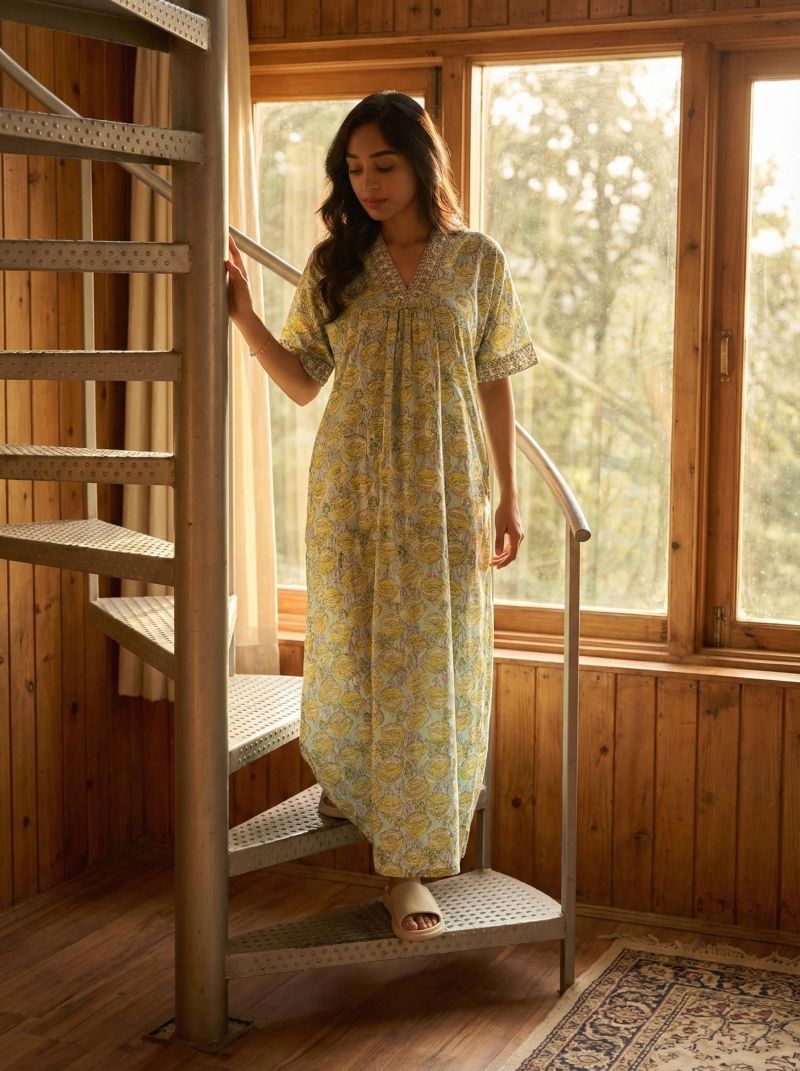
This is why I care about how nightwear is being reimagined today. The woman in the YELLOW BLOOM night dress in this image is not dressed for sleep or spectacle. She is moving through her day, in her own space, in a garment designed for real life rather than performance. That shift, subtle as it looks, is where real design begins.
The next revolution in women’s clothing won’t come from runways.
It will come from what we were told didn’t matter.




Leave a comment
This site is protected by hCaptcha and the hCaptcha Privacy Policy and Terms of Service apply.